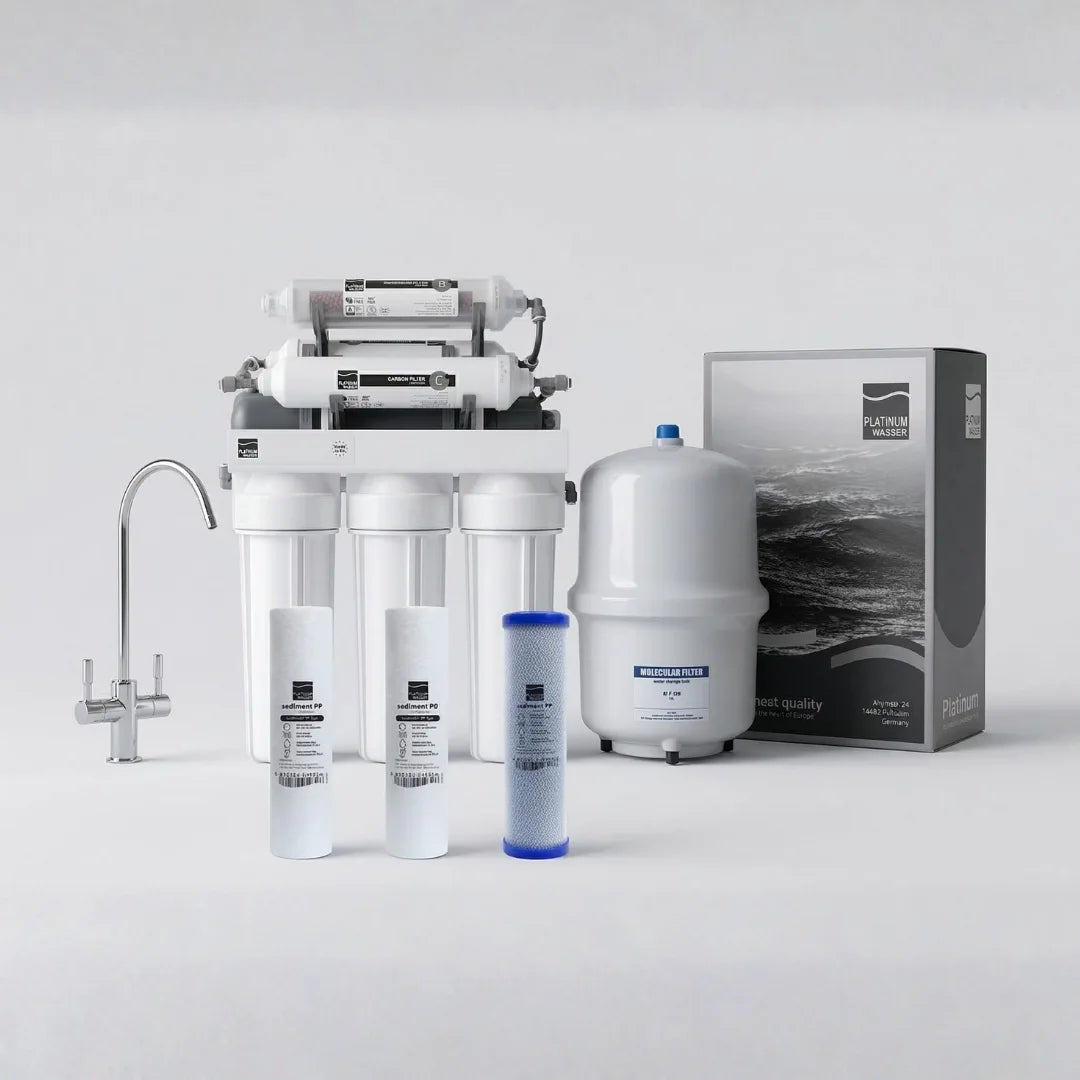


When should you change a water filter cartridge?
Installing a home water filtration system is one of the best decisions for health and daily comfort. A water filter is not an expense—it’s an investment in your and your family’s health. However, simply installing a filter is not enough. For the system to function properly, it requires proper maintenance and timely replacement of its cartridges.
Each element in a filtration system has its own lifespan. Over time, the cartridge fills with sediment, particles, and the substances it removes from the water. When this capacity is exhausted, the filter no longer works as effectively as it did initially.
Why is timely cartridge replacement important?
The main purpose of a cartridge is to remove harmful substances from the water. When a filter becomes overloaded, its free space decreases, and water filtration can no longer proceed as before.
An overdue cartridge gradually loses its effectiveness. As a result, the taste of the water may change, and its overall quality may decrease.
1. What happens if you don't replace the cartridge on time?
If a cartridge is at the end of its lifespan, it can no longer reduce impurities to the same level as a new filter. This means the system can no longer provide you with the same quality of water it did initially.
2. Water taste and odor change
This particularly applies to activated carbon cartridges, which work to reduce chlorine, unpleasant odors, and tastes. When the capacity of such a cartridge is exhausted, the taste and smell of chlorine may again be perceptible in the water, and it may have a less pleasant taste.
3. Pressure and flow weaken
When sediment and mechanical particles accumulate in the cartridge, water flow becomes difficult. As a result, the flow rate decreases, water comes out slower, and the system becomes less comfortable for daily use.
4. The system no longer functions fully
Each stage of the filtration system has its own function. Delayed replacement of one element can put additional strain on the other stages, making the entire system less effective.
Are all cartridges replaced at the same time?
No. Not all cartridges have the same lifespan. The replacement period depends on the type of system, water quality, usage volume, and the specific purpose of the cartridge.
Some elements are replaced more frequently, while others are replaced less often. This is why it is important to follow the recommendations for the specific system rather than relying on general assumptions.
What accelerates cartridge exhaustion?
The lifespan of a cartridge does not depend solely on time. It can be exhausted more quickly if:
- A large amount of water is used;
- The water has high levels of sediment, rust, or other mechanical impurities;
- Chlorine or other substances are present in high concentrations;
- Water quality is unstable;
- The system is used in a large household or commercial space.
Therefore, the same cartridge may need to be replaced at different times under different conditions.
How do you know when a cartridge needs replacement?
There are several obvious signs:
- The water’s taste or smell has changed;
- Flow or pressure has decreased;
- The filter indicator signals the need for replacement;
- The recommended time has elapsed;
- The recommended liters or time have been reached.
The best approach is still not to wait for these signs but to replace the cartridge on time according to the manufacturer’s recommendations.
Why is timely replacement particularly important in reverse osmosis (RO) systems?
In a reverse osmosis system, several stages work together. Pre-cartridges protect the membrane from excessive load, while the membrane is responsible for deep filtration.
If the pre-filters are not replaced on time, the membrane also becomes more heavily loaded, reducing the system's efficiency.
Best practice
The best approach is not to delay cartridge replacement until the water's taste or flow noticeably changes. It is better to have a predetermined service interval, record the last replacement date, and use appropriate, certified, and quality replacement elements.
Conclusion
Timely cartridge replacement is not just a technical recommendation. It is an essential condition for the water filtration system to continue providing clean, safe, and healthy water.
Sources:
U.S. Environmental Protection Agency (EPA)