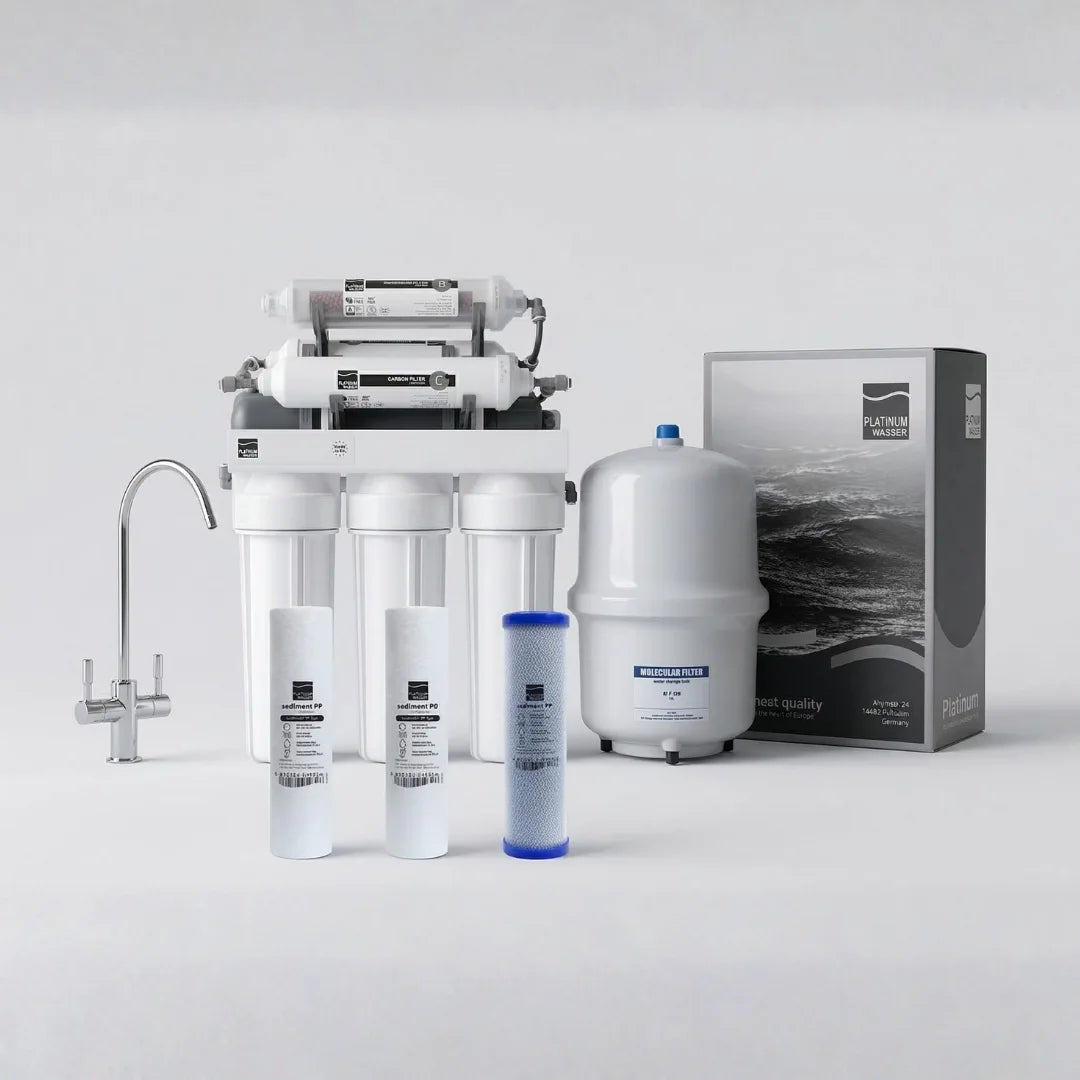


Water filter - How to choose a drinking water filter?
A water filter is one of the most important and essential devices in modern living conditions. Nevertheless, many people still don't know why in-depth filtration of drinking water is necessary and how to choose one.
In this article, we will discuss in detail:
- Why is drinking water filtration important?
- Why isn't superficial water filtration enough?
- How to choose a drinking water filter based on the corresponding contamination?
Why is drinking water filtration important?
Water filtration is particularly relevant today. Even though drinking water may be clear and odorless, it often contains substances that are visually imperceptible and negatively affect the body.
Drinking water may contain:
- Chlorine and chloroorganic compounds;
- Organic impurities;
- Heavy metals;
- Nitrates and various salts;
- Bacteria and microorganisms;
- High TDS (high mineralization).
That is why it is important for a drinking water filter to be of high quality, contributing to both water safety and the improvement of its taste and quality.
Why does drinking water need in-depth filtration?
Here is the main detail we absolutely must know - drinking water always needs in-depth filtration.
A very simple mechanical, activated carbon filter or pitcher-type water filter:
- Improves water taste;
- Reduces chlorine levels.
But cannot remove:
- Excess salts;
- Heavy metals;
- Nitrates;
- Harmful compounds dissolved in water, etc.
That is why, the more water we drink daily, the more essential an in-depth water filter becomes - especially for urban central water supply networks where network damage is common.
How to choose a drinking water filter - first steps
When we ask the question - what is important when choosing a drinking water filter, first of all, it is necessary to consider the following factors:
- Water source - central water supply network or well water;
- Biological and chemical composition of water - bacteria, cysts, heavy metals, nitrates, and other impurities;
- Water taste and odor - chlorine, organic compounds, and other factors affecting the taste properties of water;
- Water hardness and scale formation - high calcium and magnesium content, which causes scale in appliances and pipes;
- Level of mineralization in water (TDS) - the total amount of minerals, which determines both the taste of water and its balance for the body.
The type of water filtration system that will be most effective for specific water depends on these indicators.
Types of Drinking Water Filters
Activated Carbon Filter
An activated carbon filter removes from water:
- Chlorine and its compounds;
- Organic compounds;
- Unpleasant odor and taste;
- Trihalomethanes;
-
Some heavy metals.
It is effective as initial (superficial) filtration but is not sufficient for full-fledged drinking water filtration.
Ultrafiltration (UF) Water Filter
An ultrafiltration membrane effectively removes invisible harmful impurities dissolved in water, purifying water down to 0.01 microns (μm), while simultaneously retaining its beneficial minerals.
Ultrafiltration stops:
- Bacteria (E. coli, Salmonella, and others);
- Parasites (Giardia, Cryptosporidium);
- Mud, sand, rust;
- Colloidal particles;
- Water turbidity (turbidity).
Minerals remain in the water, preserving its natural taste. It is ideal for filtering municipal (central) water, but cannot reduce salts and TDS, so it is not effective for water with high mineralization.
Reverse Osmosis (RO) Water Filter - In-depth Filtration
A reverse osmosis water filter is the gold standard for in-depth purification of drinking water, especially when the water is not pre-treated or has high mineralization. It purifies water with a precision of 0.0001 microns (μm).
A reverse osmosis system removes from water:
- Heavy metals;
- Dissolved salts and minerals;
- Nitrates and nitrites;
- Biological contaminants;
- Chemical impurities;
- Microplastics and colloids.
The system provides maximally safe and stable drinking water for daily consumption. It is recommended in conjunction with a mineralization cartridge to restore beneficial minerals to the water. This is the best answer to the question - how to choose a drinking water filter, when complete control over water quality is required.
Why shouldn't you choose a water filter based solely on price?
One of the most common mistakes when choosing a water filter is making a decision based solely on a low price. In such cases, quality, safety, and long-term benefits are often overlooked.
The most common mistakes are:
- Choosing a cheap and uncertified water filter from an unknown or unverified brand;
- Lack of or insufficient in-depth filtration system;
- Problems with availability of service, spare parts, and cartridges.
A water filter is about taking care of your health, not just an accessory. A properly chosen system ensures safe water daily and reduces risks in the long term.
And still - why is drinking water filtration important?
Water makes up approximately 60-70% of our body. We consume water daily, therefore, water quality directly reflects on our health and overall well-being.
A properly chosen water filter and in-depth filtration:
- Protects health;
- Promotes metabolism;
- Ensures proper and effective hydration;
- Improves overall quality of life;
- Provides maximally safe drinking water daily.
That is why drinking water filtration is not a luxury - it is a wise and essential choice for a healthy life.